
A US Congress-constituted quasi-judicial body on Monday recommended to the Biden Administration to designate India, China, Pakistan, Afghanistan and 11 other nations as "country of particular concern" in the context of status of religious freedom.

Biden said when he got elected, Putin thought that he would easily be able to break up NATO.

India has repeatedly rejected criticism by foreign governments, lawmakers and human rights groups on allegations that civil liberties have eroded in the country.

India on Thursday condemned Omar's visit to Pakistan-occupied Kashmir.

Singh, in his address to the Indian-American community in San Francisco, also sent a subtle message to the United States that New Delhi does not believe in a diplomacy of 'zero-sum game' and its relationship with one country cannot be at the expense of the other.
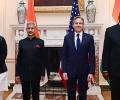
Responding to a question, Jaishankar said while the issue of human rights was not discussed during the current meeting, it has come up in the past.

It is for the first time he's publicly invoked the word genocide since Putin began his deadly assault on Ukraine on February 24.

India in the past rejected similar reports.

The demand for action by Pakistan was made through a joint statement issued after the 2+2 ministerial attended by the US Secretary of State Antony Blinken and Defence Secretary Lloyd Austin, Defence Minister Rajnath Singh and External Affairs Minister S Jaishankar.
The Biden administration has reaffirmed its commitment to support India's permanent membership in a reformed UN Security Council and New Delhi's entry to the Nuclear Suppliers' Group.
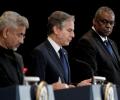
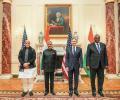
Blinken made these remarks at a joint news conference with Defence Secretary Lloyd Austin and their Indian counterparts -- External Affairs Minister S Jaishankar and Defence Minister Rajnath Singh -- after the conclusion of the 2+2 Ministerial on Monday.

India's total purchase of oil from Russia in a month is probably less than what Europe does in an afternoon, External Affairs Minister S Jaishankar said.
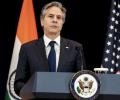
The 2+2 was attended by Secretary of State Antony Blinken and Secretary of Defence Lloyd Austin and their Indian counterparts S Jaishankar and Rajnath Singh respectively.

The virtual meeting between the two leaders came in the midst of some disquiet in Washington over India's position on the Ukraine crisis as well as its decision to procure discounted Russian oil.

Suspension is the only method provided for in the UN resolution that established the Human Rights Council back in 2005.

Two US lawmakers have introduced a bill in the House of Representatives that aims at granting an automatic right to H-4 visa holders to work in the country, a move which will benefit the spouses of thousands of foreigners, including Indians, and also address the labour shortage affecting American businesses. H-4 visas are issued to dependent spouses and children who accompany H-1B, H-2A, H-2B, and H-3 visa holders to the United States. Many H-4 visa holders are highly skilled people in their own right and previously had careers of their own or worked to support their families.

The 193-member UN General Assembly on Thursday voted to adopt a draft resolution moved by the US to suspend Russia from the Geneva-based United Nations Human Rights Council (UNHRC) over allegations that Russian soldiers killed civilians while retreating from towns near the Ukrainian capital Kyiv.

The United States Senate took the historic decision by 53-47 votes after three Republican Senators Susan Collins, Lisa Murkowski and Mitt Romney voted in her favour along with 50 members of the ruling Democratic Party.

A Green Card, known officially as a permanent resident card, is a document issued to immigrants as evidence that the bearer has been granted the privilege of residing permanently in the US.

"We do not think India should accelerate or increase imports of Russian energy and other commodities even as, obviously, those decisions are made by individual countries," White House Press Secretary Jen Psaki told reporters at her daily news conference.
 © 2026 Rediff.com - Advertise with us - Disclaimer - Privacy Policy - Sitemap - Feedback - About us - Terms of use - Grievances